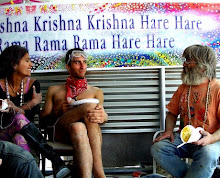
On Thursday, October 29th, I represented ISKCON and participated in a panel, organized by graduate students in the UF Religion Department, discussing religious values and the environment. The other panelists included a representative of Islam, Professor Sarra Tlili from the UF Department of Asian & African Languages, a local Jewish rabbi, and another student from Campus Crusade for Christ.
Having an undergraduate degree in environmental science and as an environmental activist for the past 15 years, my personal conclusion is that Krishna consciousness is the climax and saving grace of any environmentalist's career. I emphasized in my introductory statement why vegetarianism and simple living are two of ISKCON's most relevant values when it comes to ecological awareness. As we strive to see all living entities with equal vision, embracing vegetarianism is an immediate symptom of higher consciousness.
Naturally, vegetarianism is also a symptom of ecological awareness. As the industrialized agricultural industry and meat consumption continues to expand, the environmental impact has been detrimental. I explained that by the end of our discussion, over 1.5 million animals will have been slaughtered in the U.S. alone. What this translates into is over 55 billion animals slaughtered annually. Thus, an unprecedented demand for petroleum-based fertilizers and pesticides is needed in order to grow enough feed crops, which means more land to grow these crops, which demands one-third of the world's arable land and another 25% of the world's ice-free land to “graze” them.
I further explained that 5000 gallons of water are used to produce one pound of beef versus 25 gallons of water to produce one pound of wheat or lettuce, and that last year, the UN made a statement that 18% of global greenhouse gas emissions were attributed to the livestock industry, whereas all modes of transportation, including cars, trucks, trains, planes, and ships combined, account for a lesser 13%. I quoted manta one from the Sri Isopanisad, "isavasyam idam sarvam..." and concluded by saying that ISKCON sees the root of all sin as the deliberate disobedience of the laws of nature through disregarding the proprietorship of the Lord.
In summary, I felt the other panelists had much to say philosophically but few examples of "lived religion" or organized efforts of environmentalism in practice. An interesting point I observed was that every panelist commented on the environment as being under humanity's stewardship yet also existing for our enjoyment. After all the panelists presented their opening statement, the forum was opened up to questions from the audience. Approximately 50 students and community members were in attendance. The lively discussion that followed centered on vegetarianism, global warming, death rites, and war.
This panel is the first of a series of three. My professor, Dr. Whitney Sanford, who has a Ph.D. in Religious Studies with a specialization in north Indian devotional traditions, is very favorable towards ISKCON and recently attended the Vaishnavi Retreat at New Vrindavan. The following day, Professor Tlili approached a devotee on campus and asked for a copy of the Bhagavad-gita. In my opinion, ISKCON has an invaluable voice that must be strengthened and refined in order to be heard and understood by modern society and academia in regards to environmentalism. Yet, embracing or even discussing vegetarianism as a solution seems to be a truth even too inconvenient for Al Gore.



 I'm not sure when exactly it happened. Perhaps somewhere in between the countless planning meetings for Srila Acharyadeva's 60th Birthday Party (Vyasa Puja), or when chanting in unison the Siksastaka Prayers at 5am. Maybe it was after pulling off a rock star, 30-prep Thanksgiving dinner or while scrubbing the temple floor together and complaining about the mysterious sticky substance that won't come off. Maybe it was during lunch kirtan or at 1am after a legedary Friday night kirtan. I don't know how or when, but somehow, I've fallen desperately in love with my new community.
 It is an amazing thing to fall in love. It's as if you could be in the ugliest city in Florida, but if you have a good friend by your side, there isn't a more beautiful place you'd rather be.


 I may be experiencing the beginning symptoms of love, but I want more. This is my desire. To learn how to and what it means to love Krishna even if I drive myself (and others?) crazy during my journey. Logic leads me to love God as the most complete form of love because He is all-inclusive. No other relationship can claim all-inclusivity. You can't actually love your father without loving your mother. You can't love your mother without loving your brothers and sisters. You can't claim to love your brothers and sisters without loving their babies. And if you really love your mother, you'll even, genuinely, love her dog.